Italiana Conduttori Srl, equipped with the latest design machinery for the production of LAN cables, as well as control and testing instrumentation, produces the entire range of data transmission cables under the CAVEL brand: cat. 5e, 6, and 6A both shielded and unshielded, and categories 7 and 7A, both shielded.
LAN cables specially designed for greater flexibility (labeled with the acronym LANF) as well as special data transmission cables developed to specific client requirements are also available.
LAN cables (an acronym for Local Area Network, also called Ethernet cables) are the means by which data is transmitted within a so-called local area network, i.e., an integrated computer system consisting of shared computers and devices (such as those within a home, a business establishment, or a building complex).
Differences and characteristics of LAN/Ethernet cables
LAN cables are made up of four pairs of twisted pairs that are subsequently stranded together. The pairs have different twist pitches from each other in order to reduce interference between them, known as crosstalk (often abbreviated as NEXT, or Near End Cross Talk).
The main regulations governing the standard parameters to which LAN cables must adhere are as follows:
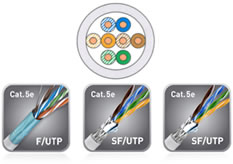
Cables Cat. 5E
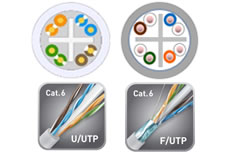
Cables Cat. 6 e Cat. 6A
Cables Cat. 7
Cables Cat. 7A
Types of shielding
The shielding of cables is necessary to protect the transmission of signals from external electromagnetic interference that could impair their quality. The different types of shielding used are presented below. Shielding is generally made from:- aluminum foils
- aluminum foils and tinned copper braid
- UTP (Unshielded Twisted Pair): unshielded cable.
- FTP or STP (Foiled or Shielded Twisted Pair): shielded cable with aluminum foil (Foiled) or tinned copper braid (Shielded).
- U/UTP: unshielded cable, with no shielding either overall or for individual pairs.
- F/UTP: shielded cable, only overall with a foil wrapping around the 4 twisted pairs.
- U/FTP: shielded cable, only on the individual pairs.
- F/FTP: shielded cable, overall with foil, and with foils around the individual pairs.
- S/FTP: shielded cable, overall with braid, and with foils around the individual pairs.
- SF/UTP: double-shielded cable, overall with braid and foil, and individual unshielded pairs.
- SF/FTP: double-shielded cable, overall with braid and foil, and individual shielded pairs with foil.
How to choose the network cable – Ethernet cable – LAN cable
| EIA TIA Category | Frequency | Standard | ISO Class 11801 (ISO/IEC) | For Ethernet installations up to no. meters of cable |
|---|---|---|---|---|
| Cat. 5e UTP | 1-100 MHz | EN 50288-3-1 | Class D | 100 m with Ethernet 10BASE-T, 100BASE-TX, 1000BASE-T, and 5GBASE-T This cable can be considered the standard LAN cable |
| Cat. 5e FTP | EN 50288-2-1 | |||
| Cat. 6 UTP | 1-250 MHz | EN 50288-6-1 | Class E | 100 m: 10BASE-T, 100BASE-TX, 1000BASE-T, 2.5GBASE-T, 5GBASE-T 55 m: 10GBASE-T Ideal for home use with improved signal-to-noise ratio |
| Cat. 6 FTP | EN 50288-5-1 | |||
| Cat. 6A UTP/FTP | 1-500 MHz | Class Ea | ||
| Cat. 7 (FTP) | 1-600 MHz | EN 50288-4-1 | Class F | 100 m with 10GBASE-T |
| Cat. 7A (FTP) | 1-1000 MHz | EN 50288-9-1 | Class Fa | 50 m with 40G Ethernet 15 m with 100G Ethernet Best-in-class cable for enterprise applications |
- ISO 11801 (International Standard Organisation)
- EN 50288 (European Standard)
- EN 50173 (European Standard)
- IEC 61156 (International Electrotechnical Commission)
- EIA-TIA 568 (Electronic Industries Association/Telecommunications Industry Association)
Cables Cat. 5E
Cables Cat. 6 e Cat. 6A
Cables Cat. 7
Cables Cat. 7A
Types of shielding
The shielding of cables is necessary to protect the transmission of signals from external electromagnetic interference that could impair their quality. The different types of shielding used are presented below. Shielding is generally made from:- aluminum foils
- aluminum foils and tinned copper braid
- UTP (Unshielded Twisted Pair): unshielded cable.
- FTP or STP (Foiled or Shielded Twisted Pair): shielded cable with aluminum foil (Foiled) or tinned copper braid (Shielded).
- U/UTP: unshielded cable, with no shielding either overall or for individual pairs.
- F/UTP: shielded cable, only overall with a foil wrapping around the 4 twisted pairs.
- U/FTP: shielded cable, only on the individual pairs.
- F/FTP: shielded cable, overall with foil, and with foils around the individual pairs.
- S/FTP: shielded cable, overall with braid, and with foils around the individual pairs.
- SF/UTP: double-shielded cable, overall with braid and foil, and individual unshielded pairs.
- SF/FTP: double-shielded cable, overall with braid and foil, and individual shielded pairs with foil.
How to choose the network cable – Ethernet cable – LAN cable
| EIA TIA Category | Frequency | Standard | ISO Class 11801 (ISO/IEC) | For Ethernet installations up to no. meters of cable |
|---|---|---|---|---|
| Cat. 5e UTP | 1-100 MHz | EN 50288-3-1 | Class D | 100 m with Ethernet 10BASE-T, 100BASE-TX, 1000BASE-T, and 5GBASE-T This cable can be considered the standard LAN cable |
| Cat. 5e FTP | EN 50288-2-1 | |||
| Cat. 6 UTP | 1-250 MHz | EN 50288-6-1 | Class E | 100 m: 10BASE-T, 100BASE-TX, 1000BASE-T, 2.5GBASE-T, 5GBASE-T 55 m: 10GBASE-T Ideal for home use with improved signal-to-noise ratio |
| Cat. 6 FTP | EN 50288-5-1 | |||
| Cat. 6A UTP/FTP | 1-500 MHz | Class Ea | ||
| Cat. 7 (FTP) | 1-600 MHz | EN 50288-4-1 | Class F | 100 m with 10GBASE-T |
| Cat. 7A (FTP) | 1-1000 MHz | EN 50288-9-1 | Class Fa | 50 m with 40G Ethernet 15 m with 100G Ethernet Best-in-class cable for enterprise applications |
