DVB-T2: Let’s Clarify Things – WHAT CHANGES?
The introduction of DVB-T2 and future 5G services requires a review of TV reception systems.
Below you can find recommendations on the CAVEL® cables to use in order to avoid possible interference.
DVB-T2 is the second-generation standard for digital terrestrial television broadcasting. It was developed to increase the transmission capacity of a multiplexer (mux) and ensure greater spectral efficiency. Compared to DVB-T, the increase in transmission capacity can reach up to 50%. This allows broadcasters to manage a larger amount of data, improving either picture quality or the number of channels transmitted.
There are essentially three reasons why installers will need to take action: the relocation of channels to the 700 MHz band, the possible addition of a DVB-T2 decoder, and the upgrading of systems using DVB-T transmodulators. It is also an opportunity, particularly for older installations, to carry out a complete inspection of the cabling, from the antenna section to the distribution network and finally to the user outlet.
The plans for changing frequencies and TV transmission standards, defined by the Italian Ministry of Economic Development for Italy and by the corresponding authorities in other European countries, were announced well in advance and are scheduled over an extended period. This gives the market and installers sufficient time to plan the necessary interventions and system upgrades, which in many cases will require the replacement of existing cabling. This will have a positive impact on manufacturers, among which Cavel is one of the leading European players.
The introduction of DVB-T2 and future 5G services requires a review of TV reception systems. One of the installer’s tasks is also to seriously evaluate replacing existing coaxial cable with a suitable high-quality alternative, such as the Cavel® models described on these pages, in order to prevent interference and ensure a professional installation.
 |
With the DVB-T switch-off, another portion of the UHF band is being allocated to mobile network operators. We are referring to the 700 MHz band, which by mid-2022 will be entirely dedicated to 5G services. As a result, the UHF channels assigned to 4G/5G services will extend from channel 50 to channel 69. This brings the shielding effectiveness of a reception system, and especially that of the coaxial cable used for wiring, back into the spotlight. For decades, the importance of coaxial cable and its connectors has been emphasized, as well as their marginal cost compared to the total cost of the installation and the importance of choosing quality cables and connectors to ensure long-term reliability, even under critical conditions. Today, it is almost certain that high-quality cable and connectors can no longer be considered optional. Which parameters should be taken into account? Today, shielding attenuation has become an even more important parameter than other commonly considered characteristics such as attenuation and cumulative return losses. A quality coaxial cable is characterized by its ability to minimize signal attenuation. However, with the interfering signals generated by 5G/4G base stations, the shield—consisting of the braid and foil, whether single or double—plays a crucial role in preventing interference from reaching the inner conductor of the coaxial cable and therefore the TV signal distributed throughout the installation. |
||||
 |
The Cavel® range of Class A, A+ and A++ coaxial cables
Today it is common practice to use different types of coaxial cable depending on the section of the installation being wired, and this approach is likely to become even more widespread in the future.
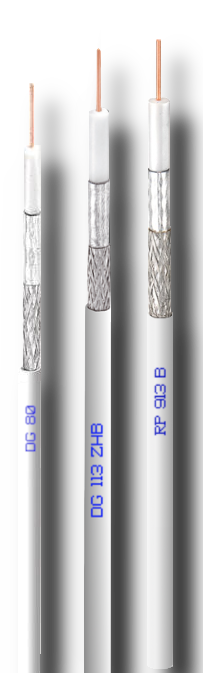
For example, any connection between the receiving antenna and the headend equipment, whether installed on a mast or indoors, should ideally be made using a coaxial cable such as the DG100 and DG113 with Class A+ shielding performance or, in particularly demanding situations, the RP913B with Class A++ shielding performance.
This is because it is essential to provide the reception system with maximum protection against current and future 5G/4G signals, since it is impossible to know in advance how close the nearest base station will be or how much power it will transmit.
Inside the building, such as in the attic, the structure itself already provides a degree of shielding. Provided that the base station is not installed on the same roof or in close proximity, a cable such as the DG70 or DG80 may be used.
Even within the home, 4G/5G signals generated by smartphones or tablets can interfere with the reception system. For this reason, it is essential to use custom-made TV extension leads assembled with Cavel® cables and connectors.
Readers can access 11 video tutorials:
Cavel® offers a range of cables with different shielding levels to protect the system throughout every area of the home. The range starts with the DG70 and DG80, Class A, suitable for floor and indoor installations, continues with the DG100 and DG113, Class A+, designed for backbone and outdoor installations, and extends to the RP913B, Class A++, for the most demanding applications.
